Why it works,
all the way down.
Engineer across software, hardware and physics. Builder of complete systems. Teacher of how they work.
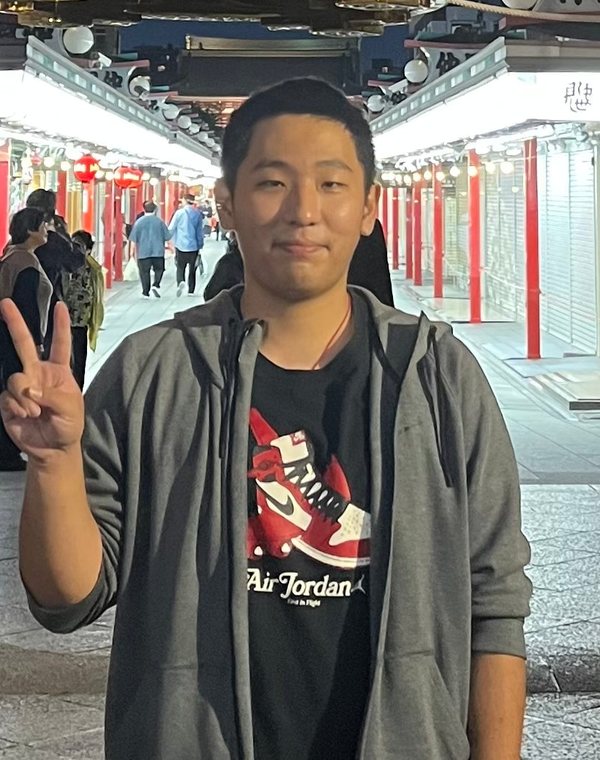
I’m an electronic engineer based in Taichung, Taiwan. I finished my M.S. in Electronic Engineering at NYUST in 2026 with a focus on computer vision.
My work runs from optics and circuits to firmware, GPU inference and deployed AI. I’m now looking for roles in smart manufacturing and embodied AI — places where software has to meet real sensors, motors and production lines.
Start from the physics
Before tuning a model or a filter, I want to know what the sensor actually measures — and why it fails.
Build for the field
Outdoor light, weather and unattended runs are part of the specification, not an afterthought.
Explain it plainly
If I can’t draw it and explain it with an analogy, I don’t understand it well enough yet.
- NowRobot arms, C++ and GPU inference
Building a robot-arm portfolio project in public while deepening C++, CUDA and TensorRT.
- 2026M.S. Electronic Engineering, NYUST
National Yunlin University of Science and Technology. Research focus: computer vision.
- 2025First author, IETAC 2025
A spatio-temporal neural network for predicting smoke dynamics.
- 2024AI smoke detection, Tainan City EPB
Government-deployed outdoor smoke detection system for the Environmental Protection Bureau.
- 2023B.S. Electronic Engineering, NYUST
National Yunlin University of Science and Technology.
- Vision & AIPYTHON · PYTORCH · OPENCV · SEGMENTATION · SPATIO-TEMPORAL MODELS
- GPU & edgeC++ · CUDA · TENSORRT · JETSON
- EmbeddedC/C++ · STM32 · ESP32 · RTOS · SENSOR DRIVERS
- FPGA & logicVERILOG · VHDL · DIGITAL DESIGN · SIMULATION
- Circuits & PCBANALOG & DIGITAL CIRCUITS · SCHEMATICS · BOARD LAYOUT
- Physics & signalsOPTICS · ELECTROMAGNETICS · DSP · PCA